.png)

Episode 215: Interview with Sonnet Daymont
- 18 hours ago
- 5 min read
Trauma touches nearly every life in one way or another. Sometimes it arrives through a single devastating event. Other times it develops quietly through years of instability, unhealthy relationships, or experiences that slowly shape the way we see ourselves and the world around us. For licensed marriage and family therapist Sonnet Daymont, understanding trauma is not simply an academic pursuit or a professional specialty. It is deeply personal.
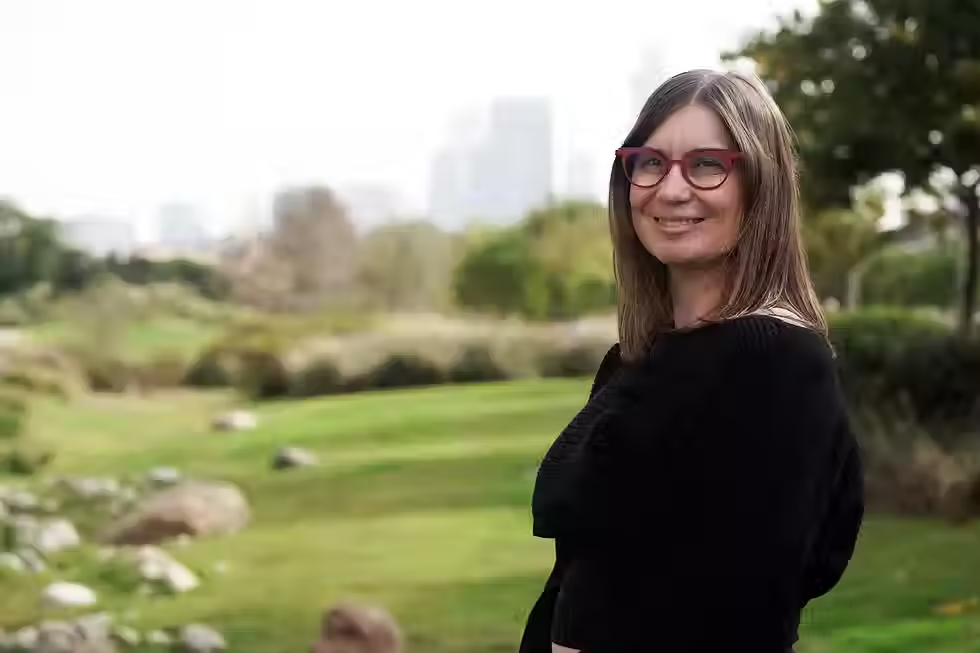
In Episode 215 of The Savoir Faire Audio Experience, Sonnet Daymont joins us for an insightful conversation about trauma, resilience, healing, and the powerful belief that trauma is treatable. Drawing from both her professional expertise and personal experiences, Sonnet offers a perspective that is both hopeful and practical for anyone struggling with emotional wounds or difficult life experiences.
As the author of the forthcoming memoir When Dangerous Feels Like Home, Sonnet has spent years examining the relationship between childhood experiences, survival mechanisms, and the patterns that often follow us into adulthood. During our conversation, she explained that her own upbringing played a significant role in shaping the therapist she would eventually become.
“I lived in an environment where I moved around and lived with different relatives at different points,” Sonnet shared. “I was an only child, so I really identified with helping people as my survival mechanism.”
Those early experiences forced her to become observant and attentive at a young age.
“I think I was a bit of an adult as a child because I needed to be,” she explained. “I was watching the world to survive. Now I’m a good listener and I’m good at watching and paying attention.”
That ability to observe and understand people would eventually become one of the foundations of her career as a therapist.
Sonnet earned dual Bachelor of Arts degrees in Psychology and Child and Adolescent Development from San Francisco State University before obtaining her Master of Arts in Counseling Psychology from the University of San Francisco. Her professional career has included groundbreaking work helping survivors of commercial sexual exploitation, and she was part of the counseling team that helped establish the first safe house for commercially sexually exploited survivors in the United States. For her contributions, she received recognition from then-Mayor Gavin Newsom.
Over the years, she has worked extensively with trauma survivors and has become particularly passionate about helping people understand that trauma does not have to define the rest of their lives.
“Trauma is treatable and it can make us stronger,” Sonnet said. “More purposeful, better at service and integrity.”
That message became a recurring theme throughout the interview.
While many people view trauma as a permanent wound, Sonnet sees it differently. She acknowledges the pain and challenges it creates but emphasizes that healing is possible with the right tools and support.
“I wholeheartedly believe that trauma is treatable,” she explained. “I have seen countless people go into therapy, look at hard things that have happened, feel through the emotions of it, get that release through crying, and then have breakthrough insights that they can use to make their lives more fun and engaging and purposeful.”
One of the most powerful parts of the conversation centered around the value of therapy itself. Many people still hesitate to seek help, often believing they should be able to handle everything on their own. Sonnet challenges that mindset.
“We’re here for such a short period of time as humans,” she said. “It’s worth it to pay attention to yourself and heal some of those wounds so that you can show up and have some joy.”
Rather than viewing therapy as a sign of weakness, Sonnet describes it as a way of learning how to better understand and navigate your own mind.
“Therapy is a way to learn how to drive yourself like a car,” she explained. “Knowing what to do when you feel sad, what to do when you feel like procrastinating, what to do when you don’t want to go visit your family because they’re unkind sometimes. It’s really important if you have long-term goals.”
During our discussion, Sonnet also broke down some of the practical approaches she uses in her work, including Cognitive Behavioral Therapy (CBT), Eye Movement Desensitization and Reprocessing (EMDR), and existential therapy.
One of the first concepts she discussed was the importance of mindful awareness and recognizing when anxiety and stress are beginning to take control.
According to Sonnet, understanding how the body responds to stress is a critical part of healing. When fear or trauma activates the nervous system, adrenaline and cortisol flood the body, often making it difficult to think clearly.
“Learning how to calm the body down yourself is part of CBT,” she explained. “Being able to tell when adrenaline and cortisol hit, when you’re anxious or worried, when you have a bad memory or you’re facing something new.”
One of the simplest tools she recommends is something almost everyone can begin practicing immediately: belly breathing.
“There are studies that show when we take these big expansive breaths in our belly, that changes the way our brain chemistry works,” she said.
While it may sound simple, she explained that controlled breathing can help regulate the body’s stress response and reduce the intensity of anxious thoughts.
The conversation also explored how people often become trapped by fears and avoidance behaviors. Using the example of someone who is terrified of spiders, Sonnet described how gradual exposure can help retrain the brain.

“You practice engaging with spiders until you’re not afraid of them at all,” she explained. “You look at pictures of them, you practice your belly breath, you remind yourself you’re safe. It’s about extinguishing the reaction of fear through showing yourself you’re okay.”
This process of facing fears rather than avoiding them is a core principle in many trauma treatments.
Another topic that resonated deeply was Sonnet’s discussion of EMDR therapy. Unlike traditional talk therapy, EMDR focuses on helping individuals process traumatic memories in a way that reduces their emotional intensity.
“It’s a therapy where you spend a whole hour talking about a trauma and the way it makes you feel about yourself while engaging the prefrontal cortex,” she explained. “So that when you think about it in the future, it’s not so activating.”
For Sonnet, EMDR is one of the most empowering forms of trauma treatment available because it helps people regain trust in themselves and reclaim control over their emotional experiences.
One of the more surprising parts of our conversation involved Sonnet’s work consulting on films, particularly horror movies. As someone who specializes in trauma, she has become a valuable resource for writers, filmmakers, and creatives looking to portray psychological experiences accurately.
“I really like horror films,” she admitted. “It is a great way to tell a story about trauma and get to the other side of it.”
She explained that horror films can serve as a controlled way for audiences to experience fear, adrenaline, and emotional release, making them surprisingly therapeutic for some viewers.
As our conversation came to a close, Sonnet shared one final message she hopes more people will hear.
“Trauma is treatable and it can make you stronger,” she said. “If I could paint that in the sky, I would.”
It is a simple statement, but one that captures the heart of her work.
In a world where so many people quietly carry emotional burdens, Sonnet Daymont offers a message of hope. Healing is possible. Growth is possible. And perhaps most importantly, people do not have to navigate those challenges alone.
Whether through therapy, mindfulness practices, EMDR, or simply learning to understand ourselves better, there are paths forward. Sonnet’s career has been dedicated to helping people find those paths and reminding them that their experiences do not have to define their future.
🎧 To hear the full conversation with Sonnet Daymont, tune in to her episode on The Savoir Faire Audio Experience, streaming now.